At 100 years, Pajaro Valley Golf Club still swinging
By NICK SESTANOVICH | nsestanovich@santacruzsentinel.com
PPUUBBLLIISSHHEEDD:: JJuullyy 55,, 22002266 aatt 1111::4411 AAM M PPDDTT
ROYAL OAKS — In the days since Calvin Coolidge was president and silent films ruled movie theaters, the Pajaro Valley Golf Club has provided lifetimes of memories for its budding and seasoned golfers.
Maybe it was where they hit their first hole-in-one, taught their kids about the most efficient swings or won their first tournament. In any case, the Royal Oaks course has provided many milestones in its 100 years, which is why it is time for the club to celebrate a milestone of its own.
General Manager Brian Robbeloth said the centennial was a “wonderful” occasion.
“It’s a great opportunity to be part of a wonderful historic place,” he said. “Pajaro has a special feeling. It’s creating enjoyable experiences for our golfing guests, both our staff and our people that play here.”
According to Mark Swartz, director of design and entitlements for the club’s current owner Parks Legacy, the front nine holes of the Pajaro Valley Golf Club were designed by professional golf legend Peter Hay who later developed The Hay course at Pebble Beach. The site had previously been home to the old Hudson Landing, a primary connecting port to deliver crops via steamboat from the Pajaro Valley.
“There were mining carts that would take the produce from approximately Salinas Road today all the way down to the (Elkhorn) Slough to load them on the barge,” he said. “Eventually, the railroad came along and disrupted that as a method of transportation for the produce.”
In those foggy days, that Central Coast residents should be very familiar with, Swartz said the barges would reportedly steer toward an oak tree which remains on the site. The site was redeveloped as a golf course with Hay’s input in 1926.
“Likely, some gentlemen who owned the land and were farming it tapped into Peter Hay’s knowledge to design the front nine of the golf course,” said Swartz.
The back nine was developed decades later by Robert Muir Graves, but the club has been largely unchanged since, with most of its changes being in its ownership. Since 2023, it has been owned by Parks Legacy, a Phoenix-based company aimed at preserving golf clubs and open space while also allowing for mixed-use development.

Eddie Duino Jr., a member of the Professional Golfers’ Association of America for more than 60 years, has been playing at Pajaro Valley Golf Club since the ’40s and has been a golf instructor at the club since 1998. His father, Eddie Duino Sr., was the PGA’s home professional of the year in 1959 and became head professional at the San Jose Country Club where Duino Jr. grew up. The younger Duino has served as head golf professional at Palo Alto Hills Golf & Country Club, Merced Golf & Country Club and Seascape Golf Club in Aptos, but Pajaro Valley stands out for its abundant nature.
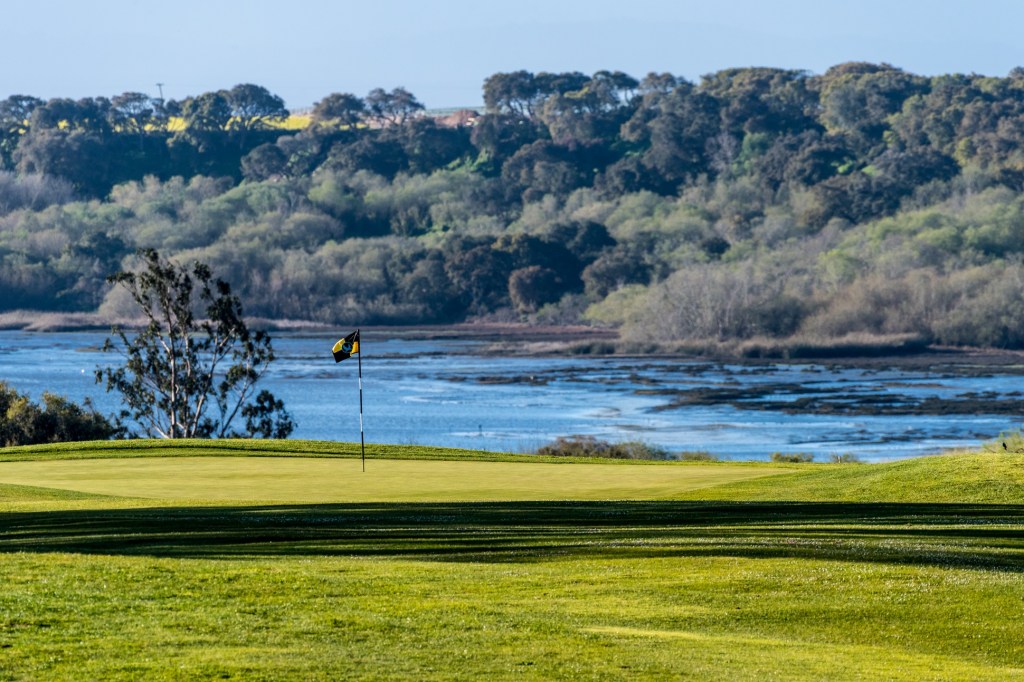
“It’s like you’re in a park,” he said. “You’ll see the animals, it’s like you’re out in the wilderness.”
Additionally, Duino Jr. said the layout of the course makes it suitable for all types of golfers.
“This is the way that courses should be designed,” he said. “Some of the modern courses are too tricked up, tricky. This is a beauty, it really is.”
Robbeloth agreed that the course is intended toward all skill sets.
“At other golf courses, it takes a long time, like six hours, to play golf,” he said. “Here, people are really proud that they can play for two and a half hours and get along with their day. I think they can play quicker here because it’s wide open. You can always find your ball.”
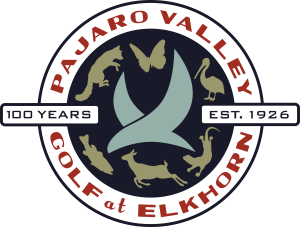
One other way Pajaro Valley Golf Club stands out is its abundance of nature. Canada geese and wild turkeys are frequent visitors, and golfers have also seen deer and foxes roaming the green. The club unveiled a special centennial logo with animals native to the Elkhorn Slough area, consisting of a pelican, butterfly, fox, trout, deer and otter.

“All of these animals can be found in the slough and the surrounding areas,” said Robbeloth.
The club also has places to decompress after a game of golf. Carmona’s Bar & Grill serves up a menu of burgers, sandwiches and breakfast while also hosting live music, special events and cornhole games. The gift shop sells a wide variety of golf accessories, apparel and books but also golf club covers in the shape of animals and a unique presentation. Visitors are instantly greeted with a ceiling mural painted by Santa Cruz artist John Crawford and a 93-inch Costco bear donning a golf club and a straw hat.
“This man has an ability you won’t find in very many golf shops,” Duino Jr. said of Robbeloth and gestured toward a display with Adirondack chairs, golf club covers in the shapes of dog heads and a plush rabbit cradling a plush taco. “This display is unbelievable. It’s creative. You don’t find this in most places, not even at Pebble Beach.”
Tucked in a corner is a “Golden Tee 3D Golf” arcade cabinet which Robbleoth bought from Costco, thinking it would be a way to generate extra money from people putting in quarters, but it turned out the machine could play games without putting quarters in.
“It was free to play,” he said. “It’s good for the kids.”
Swartz said the club is looking at its first big update since its expansion more than 60 years ago. The club worked with golf architects Forrest Richardson and Jim Urbina on a development master plan that, in its current iteration, utilizes the existing zoning to preserve 90 acres of the course while incorporating a new clubhouse, 56 RV sites, 88 golf cabins, 160 attached townhomes, fitness center, arcade, restaurant, 200-person banquet center and a commercial plaza along Salinas Road with a coffee shop, sundries market and tavern.
Additionally, Swartz said the golf course would be renovated to the tune of $10 to $12 million.
“It’s a lot of money, but it doesn’t go very far when you consider the needs of the golf course with an aged irrigation system, so we’ll spend $4 million of that $12 million underground where nobody sees them redoing an irrigation system,” he said.
Bunkers will also be renovated and cart paths updated while the terrain, topography and some trees will remain. Swartz said the new course would address environmental concerns, namely that the current course uses too much water.
“We’re cutting down the overall amount of turf which is about 110 acres today,” he said. “We’re cutting that in half to about 55 to 60 acres, so it won’t be wall-to-wall grass. That’s too much water use.”
The project is currently undergoing a consistency review from Monterey County to go over various documents and will then embark on a scoping and request for proposal process.
“It’s still got a ways to go,” said Swartz. “It’s at least two years more just getting our development plan approved if we’re so fortunate and, in the meantime, try to do everything we can to enhance a golf course that’s 100 years old.”
The club will have a variety of events over the next year to celebrate its 100th anniversary, but Swartz said details have not been finalized yet. Currently, there are centennial golf cars with discounts and plans for a party in September where the course is shut down for half a day for people to explore with food trucks, live music and merchandise giveaways on site.
“We see the centennial as a yearlong event,” he said.
The thing that stands out for Robbeloth most is the unique experiences Pajaro Valley Golf Club creates for its guests.
“It’s the product, it’s the golf course, it’s the birds, it’s the wildlife,” he said. “When you go out there and see the turkeys, you want to come back.”
By Nick Sestanovich – santacruzsentinel.com view the original article here